1127Influence of saccharide chain lengths on the glass transition temperature and water sorption of amorphous corn starch matrices
1School of Animal & Food Sciences and Marketing, Konkuk University, Korea
2Department of Food Science and Biotechnology of Animal Resources, Konkuk University, Korea
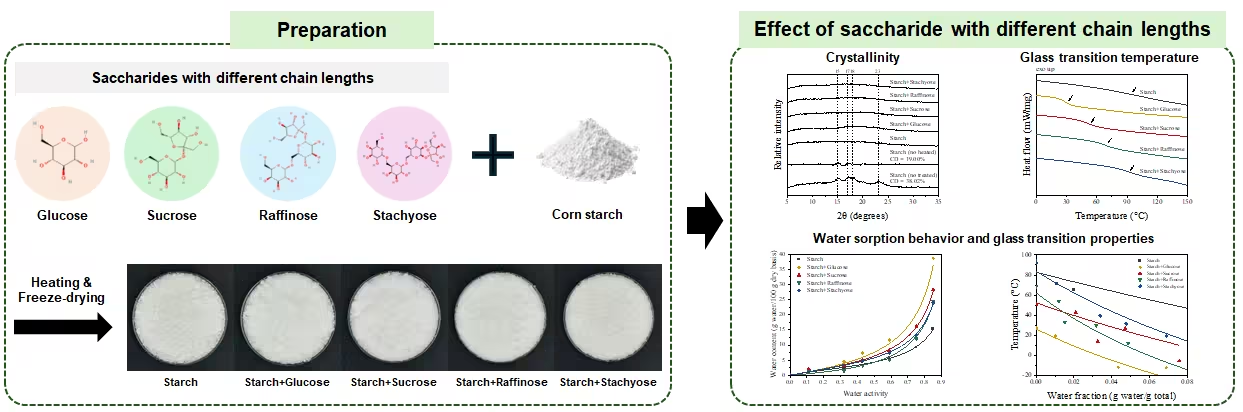
This study investigated the effect of saccharides with different chain lengths on the glass transition temperature (Tg) and water sorption behavior of corn starch. Glucose (monosaccharide), sucrose (disaccharide), raffinose (trisaccharide), and stachyose (tetrasaccharide) were selected. Corn starch and saccharide were mixed at 1:1 (w/w) ratio and dispersed in deionized water to obtain a 5% (w/v) suspension. The suspensions were heated at 95°C for 1 h, cooled to 25°C, frozen at -100°C, and freeze-dried. Optical microscopy analysis revealed non–uniformly shaped fragments and sheet–like structures, indicating the destruction of the crystalline structure. X-ray diffraction confirmed the amorphous structure of gelatinized starch. Water sorption behavior of corn starch-saccharide matrices was examined using the Guggenheim-Anderson-de Boer (GAB) model. The Tg of each sample was determined by differential scanning calorimetry. The effect of water content on the Tg for samples was analyzed using the Gordon-Taylor (GT) equation. Longer saccharide chain lengths were associated with a decrease in monolayer water contents and an increase in the C constant, indicating stronger monolayer binding energy compared with bulk and reduction of water mobility at the initial sorption sites. Such behavior reflects a matrix with restricted water mobility, leading to enhanced stability of the amorphous starch-saccharide systems. GT analysis revealed that systems with higher k values exhibited greater Tg sensitivity to water, reflecting enhanced water-plasticization during hydration. In contrast to the general pattern, raffinose presented a low C value while displaying a high k value, implying that hydration promotes extensive free-volume increase and thereby amplifies the Tg response to water. These combined results demonstrate that dual role of saccharide chain length in controlling both dry-state mobility and water-induced destabilization of starch-based amorphous matrices. Such insights are essential for predicting the stability of starch-based powdered products and guiding the design of starch-based products with improved functional properties.