1125Impact of freezing-induced glass and crystalline states in carbohydrate-protein complexes on the survival rate of probiotics
1School of Animal & Food Sciences and Marketing, Konkuk University, Korea
2Department of Food Science and Biotechnology of Animal Resources, Konkuk University, Korea
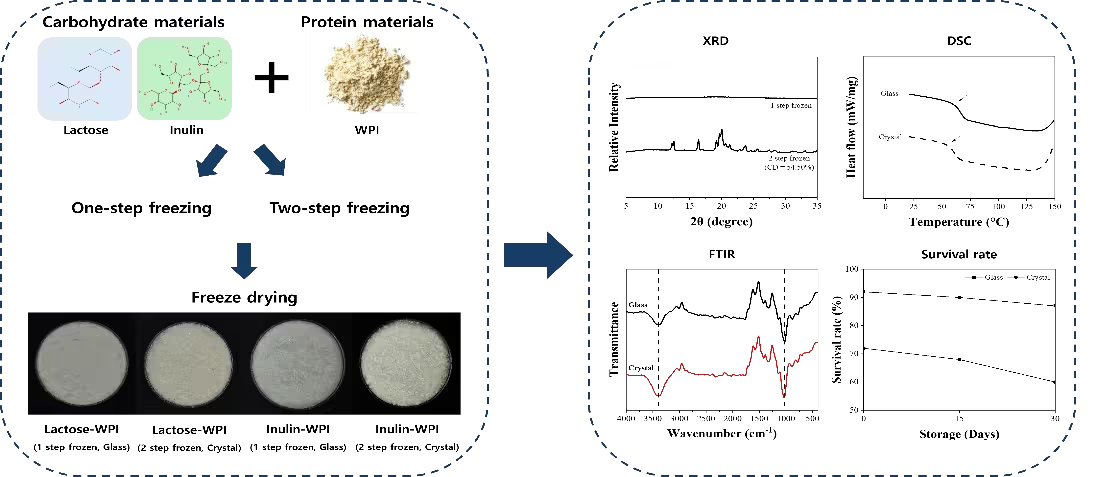
Higher glass transition temperatures (Tg) reduce molecular mobility in dried matrices, and Tg elevation has emerged as an effective approach for improving microbial stability. Therefore, this study examined how crystalline and amorphous structures influence the survival rate of
Leuconostoc mesenteroidesthroughout freezing, freeze-drying, and storage. Accordingly, whey protein isolate (WPI) was used as a protein matrix, and inulin, lactose were chosen as carbohydrate components. Each carbohydrate was individually combined with WPI. These formulations were mixed with
Leuconostoc mesenteroidesand subjected to either one-step rapid freezing at -100°C or two-step freezing at -20°C followed by -100°C prior to freeze-drying. One-step rapid freezing produced amorphous samples and two-step freezing promoted crystallization. To characterize the structural differences, appearance, X-ray diffraction (XRD), Fourier-transform infrared spectroscopy (FTIR), and differential scanning calorimetry (DSC) were performed. In addition, the survival rate during 30 days of storage was evaluated by comparing viable cell counts with those of an unfrozen control. XRD analysis confirmed the presence of crystalline structures in two-step frozen samples, whereas rapid freezing generated peak-free amorphous patterns. These structural differences were also reflected in appearance, with amorphous samples exhibiting a glossier surface than crystalline samples. FTIR confirmed these distinctions: amorphous samples exhibited broadened O–H stretching bands (3200–3500 cm⁻¹) and less-defined carbohydrate features, whereas crystalline samples showed sharp peaks indicating ordered structures. DSC demonstrated that inulin systems had higher Tg than lactose systems, and amorphous matrices consistently showed higher Tg than crystalline ones. Survival results also reflected these structural differences, with inulin formulations showing higher survival rate in amorphous glassy matrices (94% initially; 87% after 30 days) than in crystalline samples (75% initially; 66% 30 days). In lactose-based samples, amorphous matrices also maintained high survival rate (92% initially; 87% after 30 days), while crystalline matrices showed low rate (72% initially; 60% 30 days). These findings demonstrate that freezing-induced physical state and carbohydrate type determined probiotic stability, with inulin-containing amorphous matrices offering superior long-term protection