a1102Physicochemical properties and in vitro digestibility of heat-moisture treated and pressure-moisture treated rice flour
1Department of Food Science and Biotechnology, Kyung-Hee University, Yongin, Gyeon-gi, South Korea
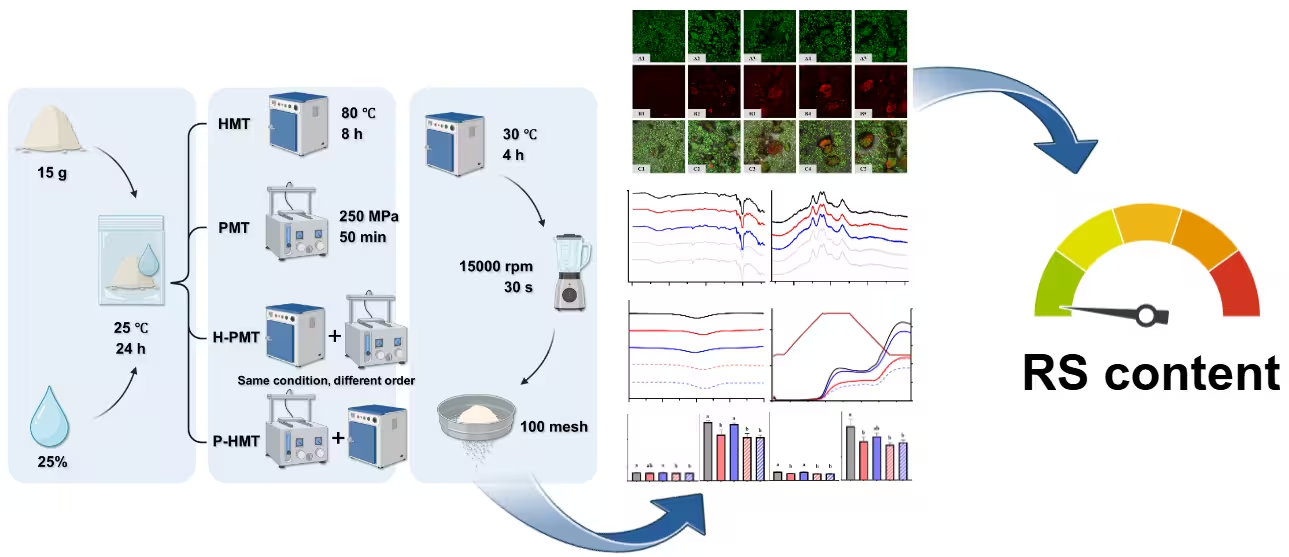
In Asia, rice has traditionally been consumed primarily in the form of cooked rice. However, with the diversification of dietary patterns, the consumption of processed rice-based foods has been steadily increasing. Responding to this trend, efforts have been made to modify starch-based ingredients such as wheat flour and rice flour to reduce their digestibility while altering their functional properties. Among the various techniques, Heat Moisture Treatment (HMT) and Pressure Moisture Treatment (PMT) are typical physical modification methods that offer improved safety compared to chemical methods. In this study, the effects of single and dual modification using HMT and PMT on physicochemical properties and in-vitro digestibility of rice flour were investigated to provide the potential of the modified rice flour as a less digestible ingredient in processed foods.
Rice flours was placed in a polyethylene pouch, and distilled water was added to adjust the moisture content to 25% by allowing it to equilibrate for 24 h. HMT was performed at 80 ℃ for 720 min, while PMT was performed at 250 MPa for 50 min. Dual modifications were carried out HMT first and followed by PMT (H-PMT) or in the reverse order (P-HMT), using the same conditions of the previous individual treatment. Physicochemical properties of rice flour were analyzed using CLSM, FTIR, XRD, DSC, solubility, swelling power, RVA, in-vitro digestibility.
CLSM results showed that Both HMT and PMT induced protein aggregation, which altered the morphology of starch granules. In all modified samples, proteins were found to form large aggregates surrounding starch granules. FT-IR results confirmed that the large aggregates observed morphologically originated from protein denaturation, while the short-range molecular order of starch remained unchanged. In contrast, XRD analysis showed that the long-range molecular order was modified, suggesting rearrangement of amylopectin double helices and altered cluster packing within the granules. HMT and dual-treated samples exhibited significantly higher thermal stability compared with the native sample, whereas PMT did not show a significant difference. HMT and dual-treated samples exhibited significantly lower solubility, swelling power, and viscosity than the native sample. Digestibility behavior differed between uncooked and cooked samples. Before cooking, protein aggregation surrounding the granules played a dominant role in limiting enzyme accessibility, whereas after cooking, the rearranged internal structures became the main factor affecting digestibility. These results demonstrate that both HMT and PMT significantly modified the morphological and structural properties of rice flour, thereby influencing its physicochemical and digestibility characteristics. Moreover, the dual treatments produced varying effects depending on the treatment sequence.
Overall, the findings suggest that physically modified rice flour produced by HMT and PMT possess potential as less digestible functional ingredients in food processing. Future studies should apply these modification methods to various rice cultivars to evaluate varietal differences and explore their potential applications in rice-based food products to assess substitutability and digestibility reduction effects.