1094Green hydrothermal valorisation of apple pomace: co-recovery of pectin, phenolics, and sugars with development of functional dietary fibres
aCentre for Sustainable Bioproducts, School of Life and Environmental Sciences, Faculty of Science, Engineering and Built Environment, Deakin University, Waurn Ponds, Victoria 3216, Australia.
bARC Industrial Transformation Training Centre for Green Chemistry in Manufacturing, Deakin University Waurn Ponds, Victoria 3216, Australia
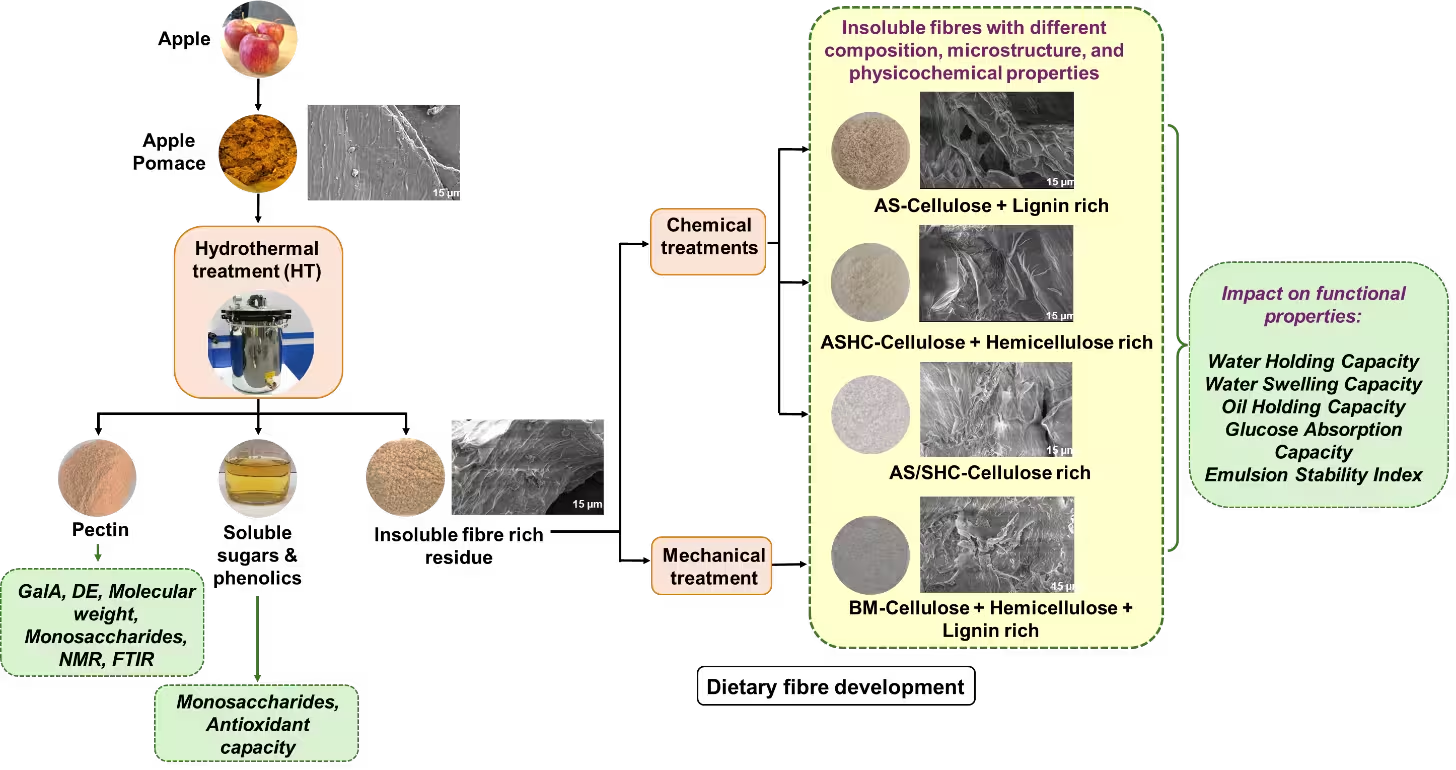
This study presents a green hydrothermal approach for simultaneously recovering pectin, phenolics, and sugars from apple pomace (AP), followed by the preparation of functional dietary fibres from the resulting fibre-rich residue. Optimised treatment at 120 °C for 15 min maximised recovery yields while maintaining phenolic antioxidant activity and minimizing pectin degradation. The extracted pectin exhibited a degree of esterification of 84.5%, uronic acid content of 83.8% and molecular weight of 161 kDa, with FTIR, 1H NMR, TGA, rheology and gelling analyses confirming structural and functional characteristics comparable to commercial and acid-extracted pectin. Co-extracted phenolic-sugar fractions were rich in glucose (92 %w/w and exhibited strong antioxidant capacity alongside a monosaccharide profile similar to conventional ethanol extracts. This sustainable hydrothermal approach enables efficient co-recovery of hydrocolloid-relevant components while reducing reliance on chemical-intensive extraction methods. Chemical (alkali, sodium hypochlorite) and mechanical (ball milling) post-treatments generated fibres with varied compositions, microstructures, and physicochemical attributes, including differences in zeta potential, particle size, and water contact angle. Chemical modifications produced cellulose-, cellulose + hemicellulose-, and cellulose + lignin-rich fibres more open microstructures, enhanced hydrophilicity, and higher surface charges relative to the compact lignocellulosic fibres generated by ball milling. Highly charged, hydrophilic, cellulose-rich fibres with thin sheet-like morphologies showed high water-holding (26.44 g/g), swelling (24.48 mL/g), and glucose adsorption capacities (11 mmol/g), whereas porous cellulose-rich fibres containing lignin and oil exhibited enhanced oil-holding capacity (19.7 g/g). Notably, hydrothermally treated fibres enriched with pectin, protein, and oil, possessed amphiphilic surfaces, small particle size, and rough morphology, which contributed to their strong emulsifying behaviour (EAI: 66.8 m2/g; ESI: 106.7 min). Overall, these findings highlight the potential of a green hydrothermal processing for producing AP-derived pectin, phenolics, and sugars, and identify key structural determinants for designing next-generation functional dietary fibres from residual biomass.
Keywords: Apple pomace; Pectin; Phenolics; Soluble sugars; Dietary fibres; Structure-function relationship, Sustainable processing
This work has been published in Food Hydrocolloids as:
Goonathilaka, P.D.S.A., Talekar, S., Holland, B.J. & Barrow, C.J. (2026). "Hydrothermal-assisted co-recovery of pectin, phenolics, and sugars from apple pomace coupled with understanding dietary fibre development via compositional, structural, and physicochemical modulations." Food Hydrocolloids 172: 112091.