1050Absorption of Enteromorpha prolifera Polysaccharides in Mice and the Protective Mechanism Against Alcohol-Induced Damage in L02 Cells
1SKL of Marine Food Processing & Safety Control, National Engineering Research Center of Seafood, School of Food Science and Technology, Dalian Polytechnic University, Dalian, China
Enteromorpha prolifera polysaccharide (EP) has previously been shown to protect against acute alcoholic liver injury in mice. To investigate the absorption potential of EP, the EP was labeled with FITC. EP-FITC was administered to mice to investigate the in vivo absorption of polysaccharides. A Caco-2 cell-based intestinal barrier model was employed to investigate EP's transport mechanism. Based on this, an alcohol-induced injury model was established in L02 cells to investigate the protective mechanisms of EP and purified EP2 fraction against alcohol-induced injury, focusing on alcohol metabolism, antioxidant capacity, apoptosis, and mitochondrial damage.
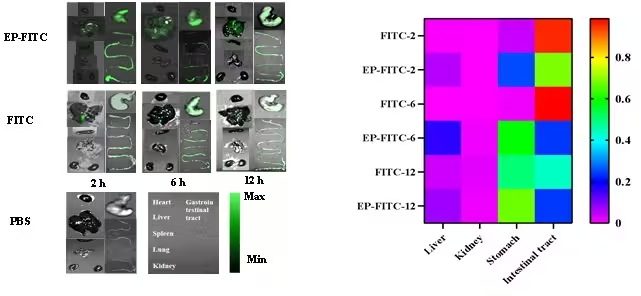
The fluorescence-tracking analysis revealed that EP-FITC appeared in the liver 2 hours after and was clearly detectable 6 hours later. Pale fluorescence was detected in the kidney 12 hours later, indicating that the EP can be excreted in the urine. Results demonstrated that EP-FITC was successfully traversing the Caco-2 intestinal barrier.
The viability of alcohol-damaged L02 cells showed a dose-dependent increase with EP and EP2 concentrations ranging from 20 to 100 μg/mL, indicating that both EP and EP2 protect L02 cells. EP and EP2 significantly restrain AST and ALT activity as well as NO and MDA levels in alcohol-damaged cells while markedly enhancing SOD activity. The optimal reduction in AST and ALT activity was observed at 100 μg/mL EP and EP2, whereas the most significant enhancement in SOD activity occurred at 50 μg/mL; EP and EP2 enhanced ADH/ALDH activity to accelerate alcohol metabolism and downregulated the expression levels of apoptotic proteins BAX, Caspase-3, and Caspase-9, thereby mitigating alcohol-induced abnormal cell apoptosis. Furthermore, EP and EP2 reduce mitochondrial damage by boosting mitochondrial membrane potential, lowering ROS buildup, and activating the Nrf2/HO-1 signaling pathway through increased Nrf2 phosphorylation. This study demonstrated that the oral polysaccharide can reach the liver to protect against acute alcoholic liver injury in mice.